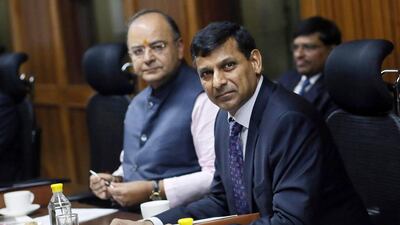
Almost a year after the Reserve Bank of India governor Raghuram Rajan, rescued the rupee from a collapse, his war on inflation remains key to safeguarding the currency.
Mr Rajan, who kept borrowing costs unchanged last week even as price gains slowed and foreign reserves climb towards a record, said developing economies with high inflation risk major market volatility when developed nations end monetary easing. The rupee tumbled 1.9 per cent to 61.095 per US dollar in one month, Asia’s worst performance, on speculation that improving US data would prompt the Federal Reserve to raise interest rates next year.
“With external vulnerability reduced significantly and foreign reserves beefed up, India is better placed to deal with the normalisation of US rates,” said Gaurav Kapur, a senior economist at Royal Bank of Scotland Group in Mumbai. “However, the weakest element in the defence against capital outflows is still high inflation.”
Mr Rajan raised borrowing costs three times since taking office in September to rein in the worst inflation among major Asian economies and avoid a repeat of last August’s sell-off that caused the rupee to sink to an unprecedented 68.845 per dollar. The currency has since rebounded about 12 per cent as global investors bought Indian assets, boosting foreign-exchange reserves to a near record $320 billion last week.
While the rate increases have helped to bring inflation below the RBI’s 8 per cent target for January next year, it is set to accelerate. Consumer prices rose 7.4 per cent last month from a year earlier, compared with 7.3 per cent in June, according to the median forecast of analysts.
Mr Rajan left the RBI’s benchmark repurchase rate unchanged at 8 per cent on August 5 and said there was an upside risk to his goal of slowing price gains to 6 per cent by January 2016. His statement dropped a June reference to the possibility of easing policy should inflation decline faster than anticipated.
The world is at risk of another financial crisis as monetary stimulus in developed economies encourages investors to take risks and boost asset prices, Mr Rajan told UK newspaper The Times. There will be “major market volatility” if investors exit their positions simultaneously, he was quoted as saying by the Central Banking Journal.
One-month implied volatility in the rupee, a gauge of expected exchange-rate swings used to price options, has risen 245 basis points from a 2011 low on July 29 to 7.75 per cent. The Federal Reserve chairwoman, Janet Yellen, said last month that US borrowing costs may rise sooner should the American labour market improve faster than anticipated by the central bank.
“The RBI’s decision to keep rates unchanged is aimed at tackling inflation and strengthening its defences in case there is a bout of volatility,” when the US raises rates, said Pradeep Khanna, the head of currency trading at HSBC Holdings in Mumbai. “The central bank has been strengthening its ammunition by increasing reserves.”
India’s foreign-exchange reserves held near an all-time high last week as global investors, who pared holdings of local-currency debt by an unprecedented $8bn lastyear, ploughed back about $14bn this year, exchange data showed. They also purchased a net $12bn of Indian equities.
Reserves swelled as RBI’s measures, along with a landslide election victory in May that swept the prime minister, Narendra Modi, to power, boosted optimism about a revival in Asia’s third-largest economy.
The shortfall in India’s current account, the broadest measure of trade, shrank to $32.4bn in the year ended March 31 from an record $88bn in the previous period, with the RBI’s curbs on gold imports being a key reason. Mr Modi’s government has pledged to reduce the fiscal deficit to a seven- year low of 4.1 per cent of GDP this year.
“While the Indian economy is better-placed to face any renewed bouts of volatility, there is a need to further augment its reserves by $66bn to increase its import cover to ten months from the present eight months,” said Radhika Rao, an economist at DBS Bank in Singapore. “Inflation remains high amid risks from weak monsoon rains.”
Inflation in India is also fanned by government support for farmers and subsides to keep food and energy prices low.
“The central bank will maintain its vigil on inflation and is unlikely to cut rates over the next couple of quarters,” said Mr Kapur. “India needs to maintain rates at the current levels to get a handle over inflation and strengthen its defences to deal with any exchange-rate volatility as the Fed prepares to raise rates next year.”
business@thenational.ae
Follow The National's Business section on Twitter