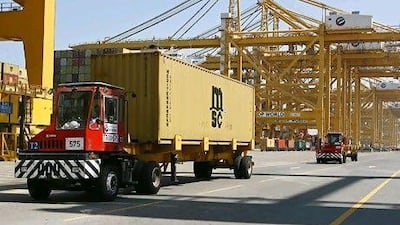
DP World is probably the best bellwether company to gauge the real economy of Dubai.
Emirates Airline might fly in the tourists and businessmen in their millions; Jumeirah might put them up while they shop and spend in the emirate.
But the financial and property sectors still struggle with downside risks.
DP World, however, is the sharp edge of Dubai Inc. About 40 per cent of the emirate's GDP goes through the port at Jebel Ali. Most of the hardware of the economy - cement, building materials, cars, engineering equipment, raw commodities - goes through its wharves.
So the forthcoming financial statement from the company, due at the end of this month, is an opportunity to assess Dubai's state of health at the end of last year.
In particular, it will go a long way to answer the question: are we at last on the brink of recovery from the economic malaise that has affected the world, as well as the UAE, since the financial crisis of 2008?
DP World has shares listed on the Nasdaq Dubai market and the London Stock Exchange and, unlike some corporations in the region, takes seriously its responsibility to keep investors aware of events that might affect the value of their investment.
So while the detailed figures will be under wraps until March 29, the market is already aware of the broad trend at DP World. And, mostly, it likes what it has been hearing.
Analysts are impressed by DP World's increasing orientation towards the world's emerging and fast-growth markets, which now account for at least three-quarters of its business. The downturn was less steep in these markets, and the recovery promises to be stronger.
They are also well-briefed on the long-term strategy of the company - to make what the experts call "value accretive investments" in new port facilities across the globe. Essentially, this means using cheap capacity in existing hubs (such as the new Terminal 3 planned for Jebel Ali towards the end of 2014) or new facilities such as London Gateway that use relatively inexpensive and demand-sensitive project finance models. And of course, the analysts like cash. DP World's business generates a lot of cash, perhaps more than its equity rating reflects.
There is one caveat. When the figures are published, it's likely the top revenue line will show a slight decline. Although this is not what you would expect at this stage of the economic cycle, it is wholly explained by an accounting tweak.
Earlier this year, DP World sold a majority interest in its Australian business, so it has decided to deconsolidate revenue from that operation. When like-for-like figures are compared, turnover will show a continuation of strong growth and the billion (Dh5.5bn) it received from the Australian sale will come through in other parts of the balance sheet.
With all this taken into account, analysts believe revenue is still likely to be above the $3 billion mark, with net income nudging the $430m level, a healthy jump on 2010’s $375m. That adds up to better quality growth than some in the markets expected.
Of course, there are factors outside DP World's control that could cloud the outlook.
Chinese growth rates have recently been shaved and other emerging markets have forecast slower economic activity. The Arab Spring, which has already affected DP World's business in Egypt and Yemen (although it has also compensated in Jebel Ali) could take an unexpected turn - fears about an Iranian confrontation could loom large again.
Iran is potentially the most worrying development but container business between Iran and the UAE is negligible and re-export of goods not covered by US sanctions (mainly through the other DP World port in Al Hamriyah, Sharjah) have so far held up well, the experts say.
The shares have recently performed well, in line with or better than many regional and global indexes. But DP World still awaits the full benefit of the London listing last summer.
The company's 80 per cent owner, Dubai World, will no doubt be pleased to see the increase in value of its equity investment, and its dividend return. But it will probably wait a while longer before considering selling more of its shares.
twitter: Follow our breaking business news and retweet to your followers. Follow us